
Litter Box Setup for a Cat With Arthritis
Cut the entrance down, put a box on every floor the cat uses, and fill it shallow with a fine litter. A stiff cat that starts going beside the box is not protesting. It is telling you the rim is now a wall.

Quick answer
- 1Cut the entrance down to about the height of a paperback. Cheapest fix, biggest change.
- 2Put a box on every floor the cat uses. Stairs are the barrier, not the box.
- 3Lose the lid and the top entry. Both ask for a climb the cat is trying to avoid.
- 4Fill it 1 to 2 inches, level, with a fine grain. Dr. Elsey's Ultra is our lowest dust reading among those, at 0.03mg per pour.
- 5Accidents right beside the box are about access, not protest. Nine times out of ten it is the rim height.
The part vets say out loud
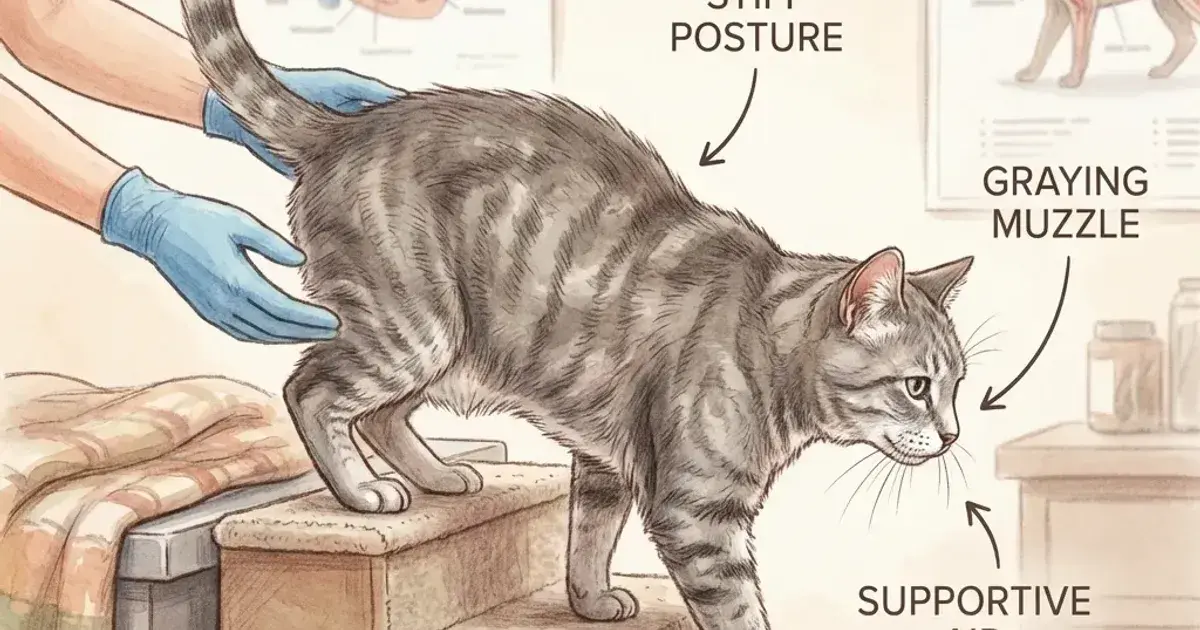
Cornell Feline Health Center says cats with painful arthritis may have difficulty getting to a litter box, especially if stairs are involved, that even climbing into the box may be painful, and that such a cat may need a box with low sides or a cut-out to allow easy access. Accidents follow from that, not from anything the cat decided.
Five changes, cheapest first
- 1
Cut a doorway in the side
A storage tub with one end cut down to about the height of a paperback, edges taped smooth, beats every box sold as senior-friendly and costs the price of the tub.
- 2
Put a box on every floor the cat uses
Stairs are the barrier, not the box. If the cat sleeps upstairs and the only box is in the utility room, the accident is on the landing and it is not the cat's fault.
- 3
Lose the lid and the top entry
Both ask for a climb. An open tray asks for a step. Whatever tracking you gain from a hood you lose in accidents beside the box.
- 4
Non-slip either side
A rubber-backed mat outside and, if the base is slick, a strip of grip tape inside. A cat that has slipped in a box once will hesitate at that box for months.
- 5
Fill it shallow
One to two inches, level. Deep loose litter shifts underfoot, which is exactly what a stiff hip does not want. It also does not last longer, so nobody wins.
What it feels like to stand on
This is the part nobody weighs, so treat it as reasoning rather than a measurement. A large hard pellet is an uneven floor. A cat with a sore hip stands on it differently, and some stop using the box rather than work it out. Fine grain gives a little underfoot instead. The lists below are sorted on grain and dust only, so scented bags appear in them. Skip those anyway.
Fine grain, easier to stand on
Clay, corn, walnut, wood, tofu and crystal, ordered by the dust we measured when pouring, least first. Crystal is the odd one out here: the beads are small but they are hard, so watch how the cat stands on those.
- Dr. Elsey's Ultra (0.03mg)
- Dr. Elsey's Cat Attract (0.04mg)
- Boxiecat Premium (0.04mg)
- Tuft + Paw (0.05mg)
- Sustainably Yours (0.11mg)
- Naturally Fresh Walnut (0.13mg)
- World's Best Cat Litter (0.15mg)
- Catalyst Soft Wood (0.15mg)
- Fresh Step Scented (0.42mg)
- Arm & Hammer Clump & Seal (0.45mg)
- Arm & Hammer HardBall (0.48mg)
- Purina Tidy Cats (0.50mg)
- Arm & Hammer Super Scoop (0.52mg)
- Frisco by Chewy (0.58mg)
- PrettyLitter (not measured)
Large pellets, harder underfoot
Both of these are excellent litters and both are very low on dust. That is why they get recommended to older cats. Try them, but watch how the cat stands.
- Feline Pine (0.08mg)
- Ökocat Paper Pellet (0.00mg)
If the cat is already happy on pellets, leave it alone. Changing a litter an old cat accepts, to solve a problem it does not have, is how you create a new one.
Five signs it is the joints, not the litter
- Front paws in, back paws out, going over the edge rather than climbing in.
- Standing in the box a long time before squatting, or squatting half in.
- Accidents right next to the box rather than in another room. Almost always access, not protest.
- Only the upstairs box gets used, or only the downstairs one, and it changed recently.
- Hesitating at the rim, then walking away and coming back.
Any of these is worth mentioning to a vet, because arthritis in cats is treatable and badly under-diagnosed. Cats hide limping. They do not hide a box they have stopped being able to use.
Questions people ask
What kind of litter box does an arthritic cat need?
One with low sides or a cut-out entrance, on the floor the cat already uses, with no stairs in the way. Cornell says arthritic cats may find even climbing into the box painful, which prompts them to go elsewhere, and that such a cat may need a box with low sides or a cut-out for easy access.
What is the best litter for a cat with sore joints?
A fine-grain litter laid shallow. Large hard pellets are a lumpy floor to stand on, and a cat that is uncomfortable will shift its weight or leave. Keep it unscented and keep the dust low, since older cats are often the ones with breathing trouble too.
My old cat pees right next to the box. Is that spite?
No. Beside the box is the classic sign the box itself is the problem. Nine times out of ten it is the rim height. Cut the entrance down and see what changes before you change anything else.
Should I move the box closer to where my cat sleeps?
Add one there rather than moving the old one. Keep the familiar box in place and give the cat a nearer option, so nothing is taken away while the new spot proves itself.
Do the cheap fix first
Cut down one box, put it beside the old one, and give it a fortnight. If the accidents stop, you have your answer for the price of a storage tub, and you know to do the same on every floor. If they do not, it was never the rim, and that is worth knowing before you buy anything.
Purrify - the additive we use in our own homes
Activated carbon you add to the litter you already buy. We have used it in our own homes for years, and with dozens of friends and family. You can keep your existing base litter.
Read our Purrify guide to picking a litter for odor control.
- Activated carbon, sold in bags
- 5.0 Google rating
- Stocked in 40+ pet stores across Canada
Access and box-height guidance is quoted from the Cornell page linked above. Dust readings are our own. We have not measured how litter texture feels to a cat, and the section on grain size is reasoning, labelled as such.