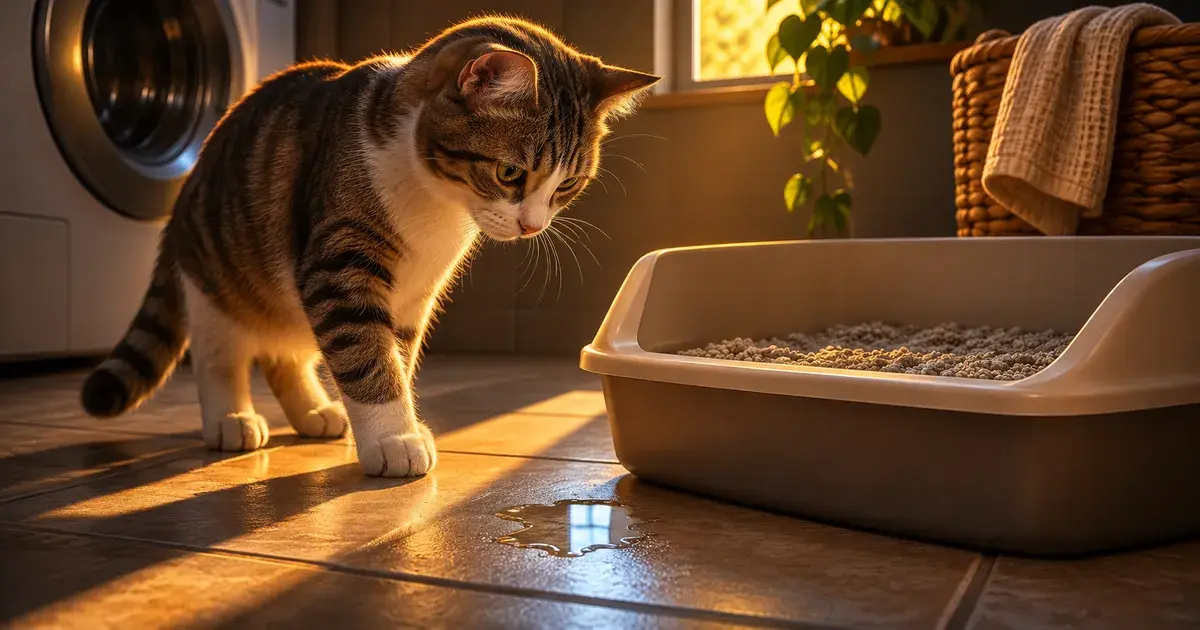
Signs of a urinary problem
Cornell Feline Health Center lists these as signs of lower urinary tract disease:
- Difficult or painful urination, or crying out while urinating
- Going more often than normal
- Blood in the urine
- Frequent licking of the genital area
- Peeing outside the box
The ASPCA adds that a cat with cystitis may try to urinate often and look as if it is straining with little success, may lick where it urinates, and may have blood in the urine. It also says cystitis can be life threatening and must be treated right away by a vet. A cat that keeps going back to the box and produces only a little urine may have a urinary tract infection, and the ASPCA says to see a vet.
Blood in the urine or peeing outside the box on its own does not tell you what is wrong. It tells you to book an exam.
Is it a spray or an accident?
The two have different causes. Watch your cat, or set up a camera for when you are out, as Cornell Feline Health Center suggests.
Peeing outside the box
Your cat squats and passes urine on a horizontal surface, says International Cat Care. Common spots are carpets, sofas, duvets, baths and sinks. A cat that dislikes its box tends to go on a variety of surfaces and may still use the box now and then.
Spraying
Your cat stands, lifts its tail and quivers it, and sprays small puddles on vertical surfaces such as chair backs and walls. Cats do not squat to spray. Common spots are doors, windows, around cat flaps, curtains and bags.
Cornell describes spraying as a way for a cat to announce its presence, mark territory or advertise that it is ready to mate. Cats that spray are mostly unneutered males and, less often, unspayed females, but about 10% of neutered males and 5% of neutered females spray too. Triggers include a new cat in the home, outside cats nearby, and the smell of new furniture or carpet. VCA notes that a cat may sometimes mark with small amounts on a flat surface, so a flat spot does not rule spraying out.
A young cat that has not been neutered and starts spraying is most likely becoming sexually mature, and neutering should prevent it, according to International Cat Care. Its first step is to contact your vet. It also warns that spraying can come and go with whatever is stressing the cat, and that the longer you wait, the more complicated it gets.
Medical causes the vet will look for
The ASPCA says the first step is to rule out urine marking and medical problems with a thorough vet exam. Cornell adds that cats with medical conditions may not act sick, so a cat that looks fine is no reason to skip it.
- Bladder and urinary tract disease. VCA Animal Hospitals names stones and crystals in the bladder, bacterial infections, and inflammatory diseases of unknown origin that cause pain and urgency. Cornell says feline idiopathic cystitis is the most common diagnosis in cats with urinary signs, and that stress seems to be an important factor in it.
- Urinary stones. They can irritate or block the bladder or urethra, and males are at increased risk of a blockage from them.
- Kidney disease, thyroid disease and diabetes. Cornell says these often lead a cat to drink more and urinate more often.
Pain can teach a cat to avoid the box. Cornell says a cat that links the box with pain may start going elsewhere, and the ASPCA says that link may keep it away even after its health is back to normal. VCA says behavior help may be needed to get a cat back to the box after the medical problem is treated.
If the vet finds nothing: box, litter, place, stress
The box
The ASPCA lists a dirty box, too few boxes, a box that is too small, a hood or liner, litter that is too deep and a box that is hard to reach as box problems. Some cats refuse a box with any urine or feces in it, per Cornell. Scoop more often with how to clean a litter box. Cornell recommends one more box than the number of cats, and our litter boxes per cat guide covers the count. If you use a self-cleaning box and your cat starts going elsewhere, the ASPCA suggests trying a traditional one.
The litter
Cornell says your cat may dislike the litter, especially after a sudden brand change, and that a switch should be gradual, adding small amounts of the new litter to the old. See how to switch cat litter.
The spot
If your cat soils in just a few places, the ASPCA suggests putting litter boxes there. It also suggests lights in dark areas.
Stress and other cats
Moving, new animals or family members, and even a changed routine can make a cat anxious, says the ASPCA. Its advice is to add boxes where the anxious cat spends most of its time, keep the routine predictable, and close blinds so outside cats do not upset it. It says synthetic pheromone sprays or diffusers have some effect in easing stress, so they may help. Cornell says stress and routine changes can raise the risk of urinary disease as well. In a home with several cats, see the multiple cats litter guide. If you cannot tell who is peeing, the ASPCA suggests asking your vet about a harmless dye that glows under UV light.
Cleaning up, and what not to do
Cornell says cats re-soil and re-spray areas that carry their scent, so cleaning is crucial and works best soon after the accident. Use a cleaner that neutralizes odor, such as an enzymatic product (VCA Animal Hospitals). Cornell advises against products with ammonia or vinegar, because they smell like urine and can irritate, and iCatCare also warns against ammonia.
Do not scold or punish. Cornell says punishment is ineffective and the anxiety it causes may make the soiling worse. If a vet suggests medication for spraying, Cornell says it can only be part of the solution.
Questions people ask
Why is my cat suddenly peeing outside the litter box?
A medical problem is the first thing to rule out, and urinary trouble is one of the main things a vet checks. Cornell lists peeing outside the box as one sign of lower urinary tract disease, and notes that cats with a medical condition may not act sick. Book a vet exam first. If the vet finds nothing, look at the box, the litter, where the box sits, and anything that has changed at home.
Is my cat spraying or just peeing?
Watch the posture. A cat that pees squats on a flat surface and passes a puddle. A cat that sprays stands, usually against a vertical surface such as a wall or door, lifts and quivers its tail, and leaves a smaller amount of urine behind it. A cat that sprays regularly still uses the box as well, says the ASPCA.
My male cat keeps going to the litter box and nothing comes out. What do I do?
Get him to a vet immediately. Straining with little or no urine can mean a urethral obstruction, which Cornell calls an absolute emergency. Do not wait to see if it passes, and do not try to treat it at home. If your own clinic is closed, call an emergency vet.
Can stress make a cat pee outside the box?
Yes. The ASPCA lists moving, new animals or people in the home, and even a changed daily routine as things that can make a cat anxious enough to stop using the box. Cornell adds that stress seems to be an important factor in feline idiopathic cystitis.
Should I punish my cat for peeing on the carpet?
No. Cornell says punishment is ineffective and the anxiety it causes may make the problem worse. iCatCare puts it plainly: your cat is not seeking revenge, and something has gone wrong in their world. Clean the spot with a cleaner that neutralizes odor and look for the cause instead.
What should I clean cat urine with?
A cleaner that neutralizes odor, such as an enzymatic product, per VCA. Cornell and iCatCare both say to avoid ammonia, which smells like urine, and Cornell adds vinegar to that list. Clean soon after the accident, because cats tend to go back and re-soil or re-spray spots that still smell of them.
My cat is healthy now but still pees outside the box. Why?
VCA says a cat that has gone outside the box for medical reasons may learn the wrong spot, so behavior help may be needed even after the illness is treated. The ASPCA says the same about pain: the association with the box can linger after the cat is well again.