
Why Is My Cat Pooping Outside the Litter Box?
Why is my cat pooping outside the litter box? Rule out pain and constipation first, then check the box, the litter, the spot and what has changed at home. The vet comes first for any sign of pain or constipation.
Is your cat trying to poop, or to pee?
VCA Animal Hospitals says a constipated cat going in and out of the box looks similar to a cat with a urinary disorder. A cat straining with little or no urine may have a urethral obstruction, which Cornell Feline Health Center calls an absolute emergency. If you cannot tell whether your cat is trying to pee or poop, go to a vet now.
Peeing is covered in why your cat is peeing outside the litter box.
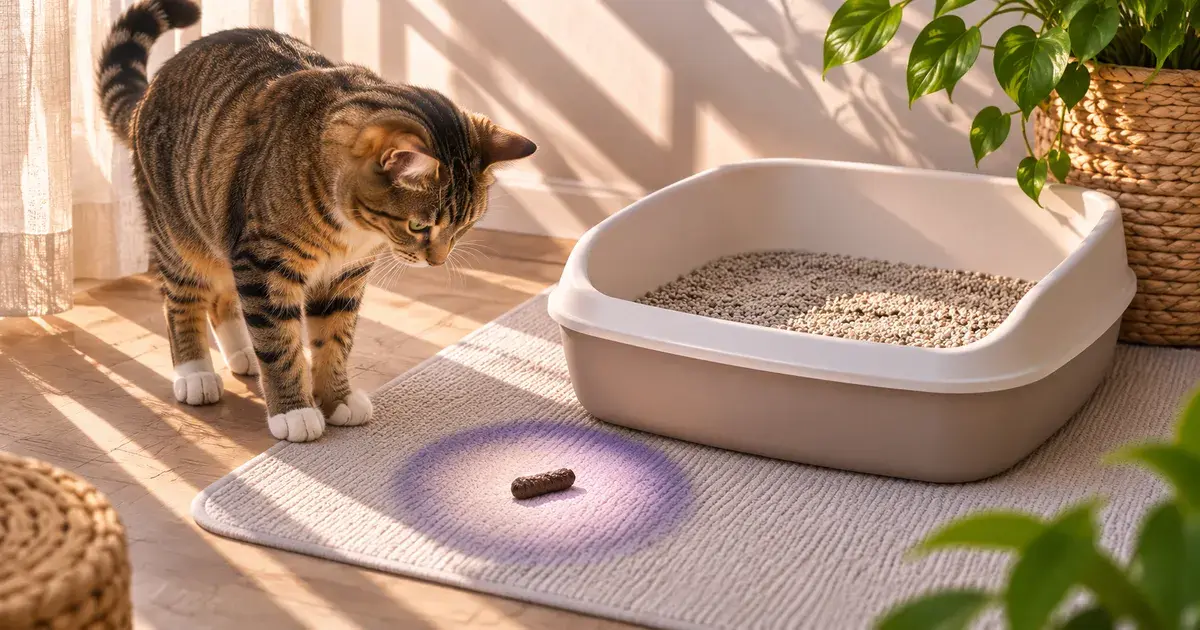

Quick answers
- 1Why is my cat pooping outside the litter box? Start with pain or constipation, because a cat that hurts when it poops can link the box with the hurt.
- 2Straining in the box is not always constipation. A cat that strains and passes little or no urine may be blocked, which is an emergency. If you cannot tell whether your cat is trying to pee or poop, go to a vet now.
- 3If your cat strains, cries in the box, or has gone 48 to 72 hours without a bowel movement, call your vet.
- 4If the vet finds nothing, work through the box, the litter, the spot and stress, in that order.
- 5Never punish it. That can make the problem worse.
Rule out pain and constipation first
Cornell Feline Health Center says any medical condition that interferes with normal defecation can cause litter box problems. Digestive trouble can make pooping painful, make the urge more urgent and cut a cat's control. A cat that links the box with pain may go elsewhere, and ASPCA says that association can outlast the illness, so the habit can stay after the cat is healed.
Cornell also warns that cats with medical conditions may not act sick. A cat that seems fine can still have a reason to avoid the box.
Signs of constipation
VCA Animal Hospitals describes them. Many constipated cats strain or seem in pain when they try to go. They may go in and out of the box, strain or cry in it, or poop outside. The stool can be small, hard and dry, or a very small amount of watery stool, sometimes with mucus. VCA notes that the liquid is sometimes mistaken for diarrhea, when it is really a little fluid squeezing around a hard mass. Lower appetite, lethargy and vomiting can go with it.
VCA says most cats poop about once a day, and to call your vet if there is no bowel movement within 48 to 72 hours of the last one. Its list of common causes includes hairballs in long-haired cats, obesity or too little exercise, dehydration, an enlarged colon, and painful conditions such as arthritis. The vet decides what is behind it and what to do.
One more health possibility: VCA Animal Hospitals names colitis alongside constipation as a reason cats poop outside the box. It also says stool in a straight line can mean constipation, or a cat pooping while it flees another cat.
If an older or stiff cat struggles to climb in, read our guide to litter boxes for a cat with arthritis. Pooping next to the box can be a mobility problem, not a behavior one.
While you wait for the appointment, keep a clean box available. VCA says constant access to one encourages frequent defecation. A diary of when and where your cat goes helps the vet and you: VCA notes most cats are regular, so a change stands out.
Then look at the box
Once medical problems are treated or ruled out, VCA says pooping outside the box is handled much like peeing outside it. The cause may be a surface or location preference, or the cat avoiding the box, the litter or the spot. Work through those in turn.
Cleanliness comes first. ASPCA says virtually all cats like clean boxes and suggests scooping at least once a day. Cornell says some cats refuse any box that holds urine or feces. International Cat Care goes further: it says cats like to pee in one area and poop in another, and that solids should come out at least twice a day. Our litter box cleaning guide covers the full wash.
Check for the signs Cornell lists: crying in the box, refusing to bury waste, perching on the edge without touching the litter, or going right beside it. If you see any, first make sure the box is clean.
Then look at the box itself. The ASPCA lists a box that is too small, and a hood or liner the cat dislikes, among the causes. International Cat Care says the box should be big enough for the cat to turn around in. Not enough boxes is another cause: the ASPCA recommends one per cat plus one, and our guide to how many litter boxes per cat shows how to set that up.
Check the litter
Cornell and the ASPCA say most cats prefer unscented, finer litter. Cornell adds that a brand change should be gradual. A cat that likes soft surfaces may do better with a softer, finer litter; Cornell even suggests a carpet remnant in the box. The cleanest way to find out what yours likes is the ASPCA's suggestion: put different litters in boxes side by side and let the cat choose.
If the trouble began right after you changed litter, that is a separate problem with its own fix. Go to what to do when your cat won't use the box after a switch.
Check where the box sits
The ASPCA says to keep food bowls away from the box, and a quiet spot beats a noisy one next to a machine. Cornell asks whether another animal ambushes your cat in the box or on the way out. If so, it suggests a box placed so the cat has more than one way out, and several boxes in several places.
If your cat poops in just a few spots, the ASPCA suggests putting a box in those spots. For a cat that avoids the box out of fear, read litter box placement for a nervous cat. If you share your home with several cats, our multiple cats litter guide covers the setup.
Then think about stress
The ASPCA says stress can cause litter box problems, and that moving, adding a pet or family member, or changing your daily routine can make a cat anxious. International Cat Care says cats are most vulnerable when they are toileting, so a cat that feels threatened may stop using the spot, and other cats are usually the biggest cause.
Cornell offers one trick for finding the culprit in a multi-cat home: feed one cat small pieces of a brightly colored, non-toxic child's crayon, which will show up in the stool. Ask your vet before trying it.
What to do today
- Look at the stool and your cat's behavior. If you see any sign from the first section, book the vet now.
- Keeping the box scooped while you wait is fine. Do it now, and keep it up.
- Clean each accident with an odor-neutralizing cleaner, not ammonia or vinegar.
- Put a box where your cat has been going.
- Start a diary of when and where.
Do not punish your cat. Cornell Feline Health Center says shouting, hitting and rubbing a cat's face in the mess are ineffective, and the anxiety may make things worse. Cornell adds that cats probably lack the thinking revenge would need.
Peeing on the floor has a different list of causes, with its own warning signs. If that is your problem as well, or instead, read why your cat is peeing outside the litter box.
Questions people ask
Why is my cat pooping outside the litter box all of a sudden?
Pain or constipation is the first thing to rule out. Cornell says a medical condition that affects defecation can cause it, and VCA says medical problems must be ruled out first. After that, the usual suspects are a dirty or unwelcome box, a litter the cat dislikes, a bad spot for the box, and stress.
How long can a cat go without pooping?
VCA says most cats poop about once a day, and tells owners to call the vet if a cat has not had a bowel movement within 48 to 72 hours of the previous one. Straining, crying in the box, or going in and out of it without result are reasons to call sooner.
Is my cat pooping outside the box to get back at me?
No. Cornell says cats probably do not have the kind of sophisticated thinking that revenge would need. VCA adds that stool is rarely, if ever, used for marking. The cat is telling you something is wrong with the health, the box, the litter, the spot or the household.
Why does my cat poop right next to the litter box?
Cornell lists eliminating right near the box as a sign the box itself may be the problem, along with crying in it, perching on the edge, or refusing to bury waste. Its advice is to check first that the box is clean.
Why is my cat not burying its poop?
Cornell lists refusing to bury waste as one sign that a cat is unhappy with the box. We found no vet source that explains other reasons, so we will not guess. Start with a clean box and a litter the cat likes, and ask your vet if it continues.
Should I punish my cat for pooping on the floor?
No. Cornell says hitting, kicking or screaming at a cat does not work and the anxiety may make the problem worse. Rubbing a cat's face in its mess is ineffective too.
What should I clean the spot with?
Use a cleaner that neutralizes odor, not one that only covers it. Cornell says to avoid products with ammonia or vinegar because they smell like urine and can be irritating. iCatCare notes that once a cat has used a spot, its nose will draw it back there.
Everything on this page rests on Cornell Feline Health Center, VCA Animal Hospitals, the ASPCA and International Cat Care, linked where each point is made. It is general information. A vet who has examined your cat gives better advice than any page, this one included.