A view of the door
A cat squatting with its back to an open room is a cat that will not settle. Put the box where it can see who is coming, and it stops checking over its shoulder.

Quiet but not cornered, with a view of the door and two ways out, well away from the washing machine and the dog's bowls. A jumpy cat is not being difficult about the litter. It is refusing a spot where it cannot see what is coming.
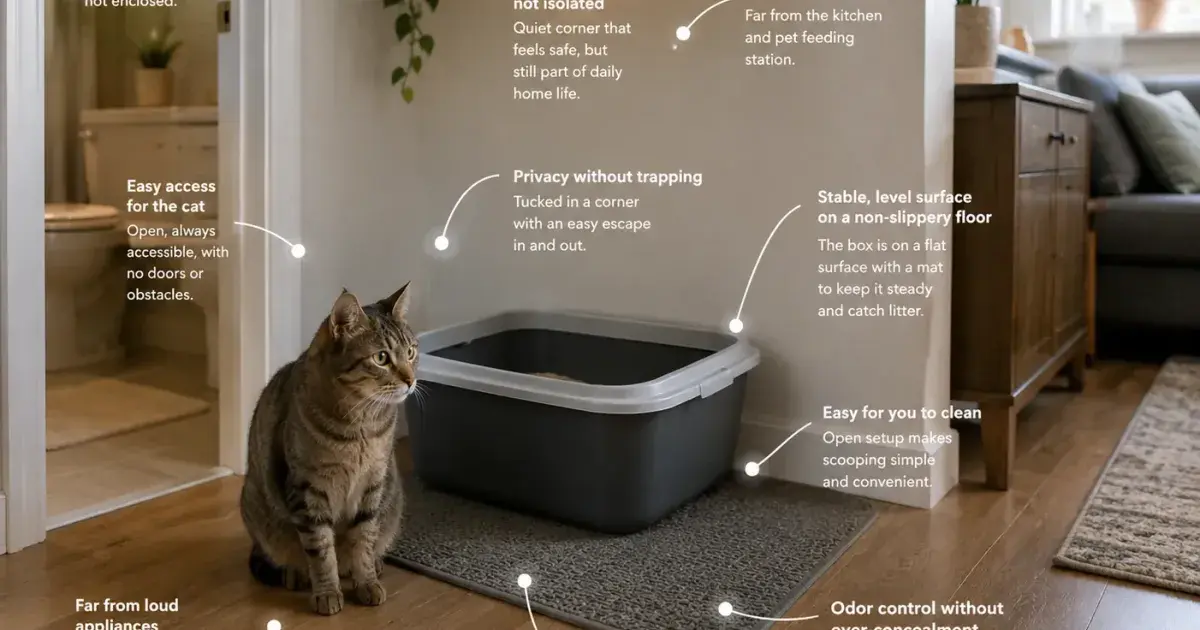

ASPCA sets the frame: cats like a box in a quiet but not cornered location, away from busy, loud or intimidating places, and they prefer a large box they can enter easily. Here is what that means in a real house.
A cat squatting with its back to an open room is a cat that will not settle. Put the box where it can see who is coming, and it stops checking over its shoulder.
A box wedged in an alcove has one exit. If anything blocks that exit once, a nervous cat writes the whole corner off.
Washer, dryer, boiler, fridge compressor, robot vacuum on a timer. One bang while the cat is mid-squat is enough to end that location for good.
Cats do not eat next to the toilet either. The dog bowl matters just as much as the dog.
| Room | Why it works | Why it goes wrong |
|---|---|---|
| Bathroom | Hard floor, quiet, a door you can wedge, and nobody lingers in it. | The door gets shut by somebody at 11pm and the cat has nowhere to go until morning. |
| Spare bedroom | Low traffic, room for two boxes, and a clear line of sight from the middle of the floor. | Out of sight means out of mind. This is the box that goes three days without a scoop. |
| Utility or laundry room | It is where people want the box, because it is where the mess belongs. | The worst room on this list for a nervous cat. The ASPCA names the washer and dryer specifically. |
| Under the stairs | Out of the way and feels sheltered. | One entrance, low ceiling, and footsteps directly overhead. A dead end with a drum kit on top. |
| Corner of the living room | Open, visible, easy to reach, and it gets scooped because you are looking at it. | You have to look at it. Screen it with a plant or an open-backed shelf, not a closed cabinet. |
Change one thing at a time, and change the location first. If you also need a different bag, these three are the ones our own testing points at for a hesitant cat.
Clumping Clay
Best for: Cats avoiding the litter box
Clumping Clay
Best for: Dust-sensitive homes
Skip if: You need flushable or lightweight litter.
Paper Pellet
Best for: Post-surgery or severe dust sensitivity
Somewhere quiet but not cornered, with a clear view of the room and two ways out, on a floor the cat already uses. The ASPCA says to keep boxes away from busy, loud or intimidating places, naming the washer and dryer and the dog bowls. That rules out most laundry rooms.
Hidden and cornered are easy to confuse. Screened from the sofa is fine. Enclosed in a cabinet with one small opening is not, because the cat cannot see out and cannot leave in two directions.
Maybe, but rule out a medical problem first. A sudden change in toilet habits is a vet visit before it is a furniture-moving exercise. Once the cat is cleared, look at what changed near the box in the fortnight before it started.
Far enough that one cat standing in a doorway cannot block both. Different rooms is the simple version, and different floors is better still.
Vet first. A cat that suddenly stops using the box may be in pain, and no amount of furniture moving fixes that. Once it is cleared, add a box rather than moving the one you have. Leave the old box where it is and put a new one in a better spot, so the cat has a choice instead of a change.
Then leave both for two weeks before you take anything away. Cats do not switch allegiance in a day, and pulling the old box early is how you end up back where you started.
Activated carbon you add to the litter you already buy. We have used it in our own homes for years, and with dozens of friends and family. You can keep your existing base litter.
Read our Purrify guide to picking a litter for odor control.
Placement guidance is sourced to the ASPCA page linked above. Product notes come from our own testing. Behaviour advice here is general, and a sudden change in toilet habits belongs with a vet first.